It began with 12...
Dyspraxic Adults-Surviving In A Non-Dyspraxic World
And now for something completely different...
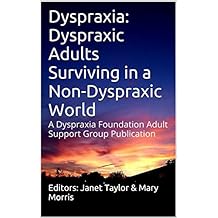
Back in 2012, a new idea was formed, an idea that was out of the ordinary. It was time for Dyspraxic Adults to work together, ask questions and provide practical coping strategies. It was time that we published a book and give our insight on what it is like living with Dyspraxia. There are so many authors who write about Dyspraxia but do not actually have it. They may have a child with Dyspraxia but at the end of the day that only means they understand glimpses of what it is like to be Dyspraxic, and to make it even more challenging parents only understand glimpses of their child's situation.
As we know Dyspraxia is different in each person, and so a parent's glimpse of Dyspraxia is limited to that child and their experience alone. I am not trying to rubbish parents of Dyspraxic children do not get me wrong, there are things we can learn from each other. I am simply stating that unless you are a Dyspraxic Adult you cannot truly and fully understand Dyspraxia.
My Dad's a man!
Talk about a no sh#t Sherlock moment! It is easy for me in the position I'm in to state "I know what it is to be a man, my dad's a man!" Well actually, truth be told I do not know what it is to be a man because (you guessed it) I'm not a man and here's another clincher; my knowledge on what it is to be a 'man' is limited to my perception of my dad. People have various definitions on what it is to be a 'man' and of course culture, beliefs, upbringing, hobbies and interests etc. come into play here. Some men believe that being a 'man' means being into the pub and football, whereas my dad hates football and doesn't drink. Does that make him any less of a man ? Or is it simply a case of individuals having different ideas of what being a man is and those ideas being limited to their experiences?
So, you can see where I'm going with this; unless you, yourself are an adult with Dyspraxia, your experience and understanding is limited to what you see. Just as my know how on being a 'man' is limited to what I see in how my Dad is.
The purpose
It was time to raise the profile of Dyspraxia and to acquire the know how of various gifted and skilled Dyspraxics; to demonstrate coping strategies and tips that we can apply to our own lives. Input from the now Adult Rep (Janet Taylor) a CAB advisor, a Psychologist, Classroom Assistants, Travel Mentor, Nurses... and there's more ( but I can not remember, all the roles) There was 12 members back in 2012, but now in 2017 we have 3700 members. Initially the information obtained was organised and compiled into the book aka Dyspraxic Adults Surviving in a None Dyspraxic World.
Dedicated to the late Mary Colley who made a bold stand for Dyspraxic adults, she will be forever missed. Now that the book is completed The book group is now being facilitated as a support group whereby Dyspraxic adults are supporting and encouraging one and other.
Facilitators
As you can appreciate a group of 3700 people cannot run itself without structure, rules and safety in place. So we have 9 facilitators aka admins who promote the smooth(ish) running of the group. All jokes aside I believe they do a fab job. The facilitators are; Janet Taylor, Ruth Emma Foley, Heather Charlotte Wainwright, Becca Surtees, Ian Scott, Thais Rodriguez, Megan Holman, Gemma Gardiner, and myself Martha Jayne. Whether it be through practical tips and or emotional support, empowerment and raising self esteem, we are willing to help you.


Comments
Post a Comment